CASE STUDY 02 / APPLIED AI
GHOSTCAT
an AI-assisted design blueprint
From instructional design problem to functional software MVP using an LLM API and lightweight Python stack.
THE CASE
Challenge
Early-stage instructional design often requires repeated manual synthesis of raw source information into a preliminary performance analysis and design starting point.
My contribution
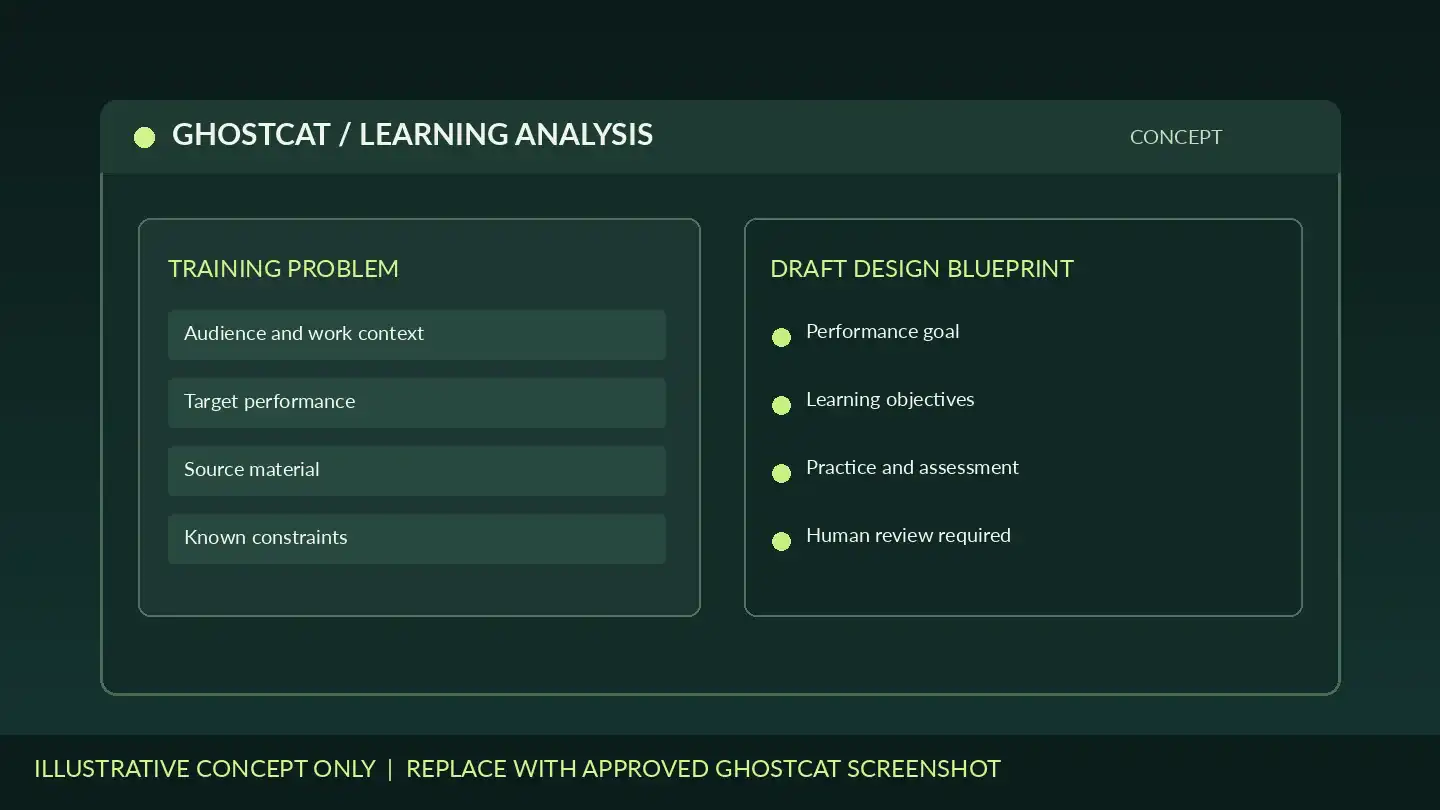
I conceptualized and built an early functioning prototype that uses OpenAI APIs, Python, FastAPI, and Streamlit to support preliminary assessment and training-design blueprint generation.
Approach
- Mapped an instructional design workflow into structured inputs and outputs.
- Built a lightweight web interface for working with preliminary analysis tasks.
- Integrated LLM calls into a Python/FastAPI-based workflow.
- Generated structured design-blueprint outputs and iterated the concept based on practical use.
GHOSTCAT / REPRESENTATIVE WORKFLOW
SourceDocuments and context02
AssessLLM-assisted synthesis03
BlueprintDraft learning structure04
ReviewHuman and SME judgment
Conceptual flow illustration. Not a screenshot of the application or a promise of fully autonomous quality.
Representative example (synthetic)
SAMPLE INPUT
New technical employees need to complete a complex equipment-check workflow consistently.
Constraints: mixed experience levels, inconsistent documentation, time-limited SMEs.
DRAFT AI-ASSISTED OUTPUT
- Target performance: complete each critical check correctly.
- Learning objective: identify errors in a simulated procedure.
- Practice: branching decision and task-based checklist.
- Validation: SME review required before publication.
This is a deliberately synthetic illustration of intended workflow logic, not a tested GHOSTCAT output.
Result
Built a functional MVP that demonstrates how AI can support—but not replace—human review, instructional judgment, and technical SME validation.
Limits and safeguards
The model can accelerate first-draft structuring, but cannot independently certify technical accuracy, job relevance, customer compliance, or accessibility. Human review, source validation, and assessment quality remain required.